5 Rules of Inspired Teaching Improv
Improvisation is an essential framework for building uncertainty tolerance and learning how to apply creative thinking to solving complex problems.
Research shows that when we’re trained in the skills of improvisation, we are well-equipped to handle the rapidly changing nature of all that is happening in the world today. Better yet, environments steeped in an improvisational mindset foster the kinds of engagement and feelings of belonging that are critical for teachers and students, as well as for organizational and corporate leaders:
Improv supports communication skills, social skills, community building, and positivity.
The 5 Rules of Inspired Teaching Improv build a community full of play, creativity, curiosity, and authentic learning.
If you are interested in creating a custom approach for your organization to spark joy, increase uncertainty tolerance, and strengthen relationships with the 5 Rules of Inspired Teaching Improv, please contact Chief Curiosity Officer Jenna Fournel: jenna@inspiredteaching.org
Learn More
↓

In improvisational theater, this means treating our scene partners as equals, enthusiastically accepting what they bring to the scene, and then building upon it.
While the word “respect” is present in most classroom or school rules, it’s the other three words that make this rule of improv something special. When we respect what others create, that means we also expect others to create. And when we set that expectation, it has implications for every facet of how we do our work as teachers.
Here’s what it looks like and sounds like in a classroom where students and teachers Respect what others create:
- Student work is prominent throughout the space.
- Students share works in progress, as well as completed work.
- Conversations abound in which students put forth original ideas.
- Meaningful feedback is offered rather than generic praise or critique.
- Students are highly aware of the personal contributions they make to the classroom community.
- All members of the community learn how to support one another, recognizing that in this environment that support is mutual.
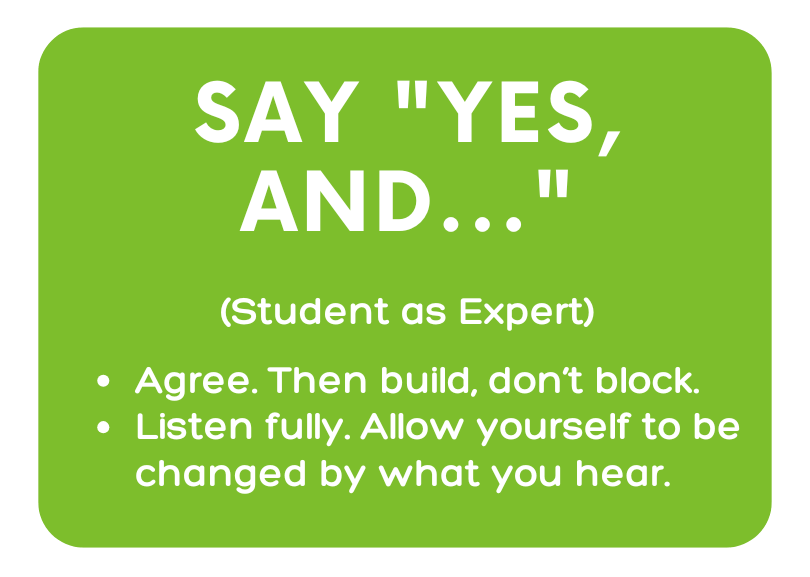
In our “Yes! And…” activity, scene partners build on each other’s ideas as they imagine a scenario that requires their cooperation.
“Yes! And…” is a fun game to play, and it’s also a productive way to live. Challenge yourself to think of all the places in your days when you might adopt this approach.
- Could you take a student up on their zany idea?
- Could you build on a colleague’s suggestion and make it even better?
- Could you try something completely new and encourage your friends or family to do it with you?
Life looks very different when we shift our mindset away from “no” or “but.” A whole new world of possibilities opens up when we challenge ourselves to start with yes!

The full rule is Know Your Goal: Stay laser-focused on where you want to go, but flexible in how you get there. Be present so you know what to do next.
As teachers, we get a lot of practice with this: the fire alarm in the middle of a test, the question from a student that makes you reconsider how you’re explaining the material, the conflict between two students that derails the lesson. You have to be on alert, using all your powers of observation to know what’s going on, and you have to be flexible in how you get to your goal as you navigate the detours.
We build our capacity to follow this rule of improv when we:
- Recognize that process and product can both be goals; often the detours are an important part of the learning process.
- Turn obstacles into opportunities.
- Allow the space and time to work on multiple goals at once.
- Convert students’ “off the wall” comments into fuel for learning.

Playing big means embracing joy and being guided by imagination. Sometimes playing big is whimsical, with no concrete goal other than to follow where your imagination leads – like a child playing dress up whose purpose may simply be to feel what it’s like to pretend to be a princess, or dinosaur, or spaceship. Other times, play is focused and goal oriented. In an academic setting, playing big means bringing your full self to solving the math problem or understanding a historical moment or researching sources for your essay or creating your work of art.
When we play big, we jump in with both feet. We commit fully to what we are doing. When we play big, we are fully present. We aren’t checking our phones or looking for something else to do. We are all in.

Toddlers cannot learn without trial and error. They must fall in the process of learning to walk. They must be misunderstood in the process of learning to talk. The truth is, for our entire lives we learn through mistakes, we get better through failure. It’s how we come to understand what does and doesn’t work. But at some point in our lives, we grow afraid of mistakes. That stunts our growth. And as teachers, it’s worth pausing to consider whether our own fear of mistakes creeps into the environment we create for our learners.
That’s why the 5th Rule of Inspired Teaching Improv is Embrace Mistakes. This means practicing failure. This means seeking opportunities to learn from what goes wrong.
To have more insights, information, and resources like the 5 Rules of Inspired Teaching Improv delivered directly to your inbox every week, subscribe to Hooray For Monday!
If you are interested in creating a custom approach for your organization to spark joy, increase uncertainty tolerance, and strengthen relationships with the 5 Rules of Inspired Teaching Improv, please contact Chief Curiosity Officer Jenna Fournel: jenna@inspiredteaching.org