
May 11, 2026
By Kim Kelley, Inspired Teaching Fellow
Listen to this week’s Hooray For Monday podcast for Meag’s conversation with Kim Kelley, teacher at Goodwill Excel Center in Washington, DC. They discuss Kim’s approach to building relationships and helping her non-traditional high school students feel seen, valued, and respected in her classroom.
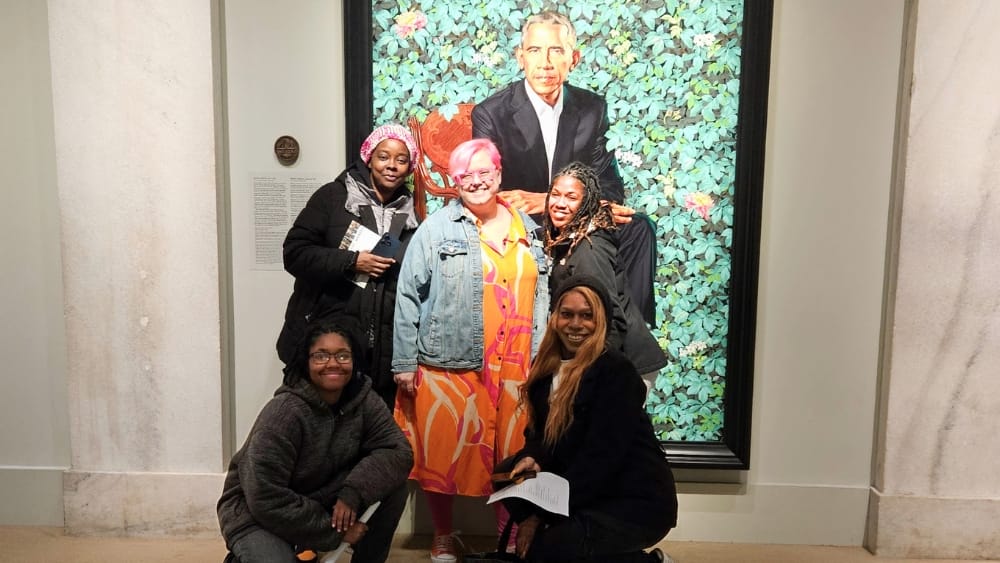
Ms. Kelley and several of her students at the National Portrait Gallery.
One of my Strategic Critical Thinking classes this term ranged in age from 18 to 64.
In that room were married students and single students. Atheists, Christians, and Muslims. Gay, straight, transgender, and nonbinary students. Some were experiencing homelessness, while others owned their homes. Some had learning disabilities, and others had taken Advanced Placement classes in high school. There were dancers, former football players, and proud self-described nerds.
On paper, it might not look like a group that would immediately connect.
But by the end of the first week, they were cheering for each other, laughing together, and building strong connections.
When students arrive at The Goodwill Excel Center (GEC), an adult public charter high school in Washington, DC, many carry years of school experiences that made them feel invisible, underestimated, or misunderstood.
At GEC, we work intentionally to build something different. We build classrooms where students feel seen, heard, and valued from the moment they walk through the door.
I am deeply proud of the culture we build across the school, and in my classrooms, that culture begins with joy, connection, and the belief that every student deserves a seat at the academic table.
Joy and connection are not extras in education. They are the beginning of healing. They are how we rebuild trust with school and make sure every student knows they belong.

In my Strategic Critical Thinking class, we begin building that sense of belonging through identity work.
During the first two weeks of the course, students created a series of small projects exploring who they are. They drew selfie portraits, wrote bio poems, designed name zines, created scratch art, and built identity charts. Each piece invited students to reflect on their experiences, values, and the many identities they bring to the classroom.
After completing those projects, we turned our classroom into what we called the Portrait Gallery Museum.
Students walked through the room studying each other’s work and leaving written responses. Instead of simply complimenting the art, they practiced thoughtful observation and reflection. They wrote about what they noticed, asked questions, and connected to specific parts of each piece.
The room slowly filled with conversations on paper.
Students began to see one another more fully. They noticed shared experiences, celebrated differences, and realized that everyone in the room carried a story worth listening to.
After the gallery experience, our class visited the National Portrait Gallery in Washington, DC. Students studied how artists use portraits to communicate identity, emotion, and story. They discussed posture, expression, color, and symbolism, and many began making connections between the artists’ choices and their own.
Those conversations prepared students for the class’s final project: The Selfie Project.
For this project, students created three original photographs that represented personal, community, and national identity. Each image was paired with a written reflection explaining the choices behind the photograph.
Students photographed places in their neighborhoods, symbols of family, moments of pride, creativity, struggle, and joy. Some images captured quite personal moments. Others highlighted culture, resilience, or the communities that shaped them.
What emerged was something powerful.
Not just selfies, but stories.
To celebrate the project, we transformed our school hallway into a gallery.

At the entrance hangs a sign that reads:
WELCOME TO OUR STORIES
Meet the New Students of The Goodwill Excel Center
“These portraits represent identity, resilience, and community.
Each student chose images that reflect who they are and who they are becoming.
At GEC, every story matters.
Every voice belongs.”
Below the sign hang the portraits and artist statements written by the students themselves.
The hallway has become a place where people stop, read, and reflect. Students pause over their own work, a mixture of pride and disbelief on their faces. Many of them have never seen their ideas displayed publicly before.
Their artist statements reveal honesty, pride, and vulnerability.
One student wrote in her artist statement,
“Through these images, I want viewers to see honesty, strength, and a deep love for life.”
Another wrote,
“I want people to understand that strength does not always appear loud.”
Other students spoke about self-worth, literacy, kindness, and authenticity. One student wrote,
“I am everything I want to be and more. I have life, and this picture shows how thankful I am for myself.”
Another reflected on the power of reading in her life:
“Reading is a passion that I am passionate about. I grew up with my grandmother always saying, ‘If you can read, you will never be lost.’”
These are not just assignments.
They are declarations of identity.
Inspired Teaching reminds us that students are experts in their own experiences. When students are given the opportunity to explore their identities and share their voices, something powerful happens.
They begin to see themselves not just as students, but as thinkers, creators, and storytellers whose lives belong in academic spaces.
Because when students believe they have a seat at the academic table, something shifts.
They take risks.
They encourage each other.
They see learning as something they are part of, not something they are excluded from.
And sometimes the most meaningful learning doesn’t happen on a worksheet or a test.
Sometimes it happens in a hallway, standing in front of a portrait, when a student quietly realizes:
That’s me.
Hooray For Monday is an award-winning weekly publication of Center for Inspired Teaching, a social change nonprofit organization that champions the power of curiosity and is dedicated to transforming the school experience from compliance-based to engagement-based. Inspired Teaching provides transformative, improvisation-based professional learning for teachers that is 100% engaging – intellectually, emotionally, and physically.
