
April 27, 2026
By Jenna Fournel, Chief Curiosity Officer
Listen to this week’s Hooray For Monday podcast for Jenna’s conversation with Michael Skinner, board president of Mott’s Neighborhood Market. Michael shares the lessons about community he learned as part of the effort to save a neighborhood grocer and invaluable third space in Capitol Hill.
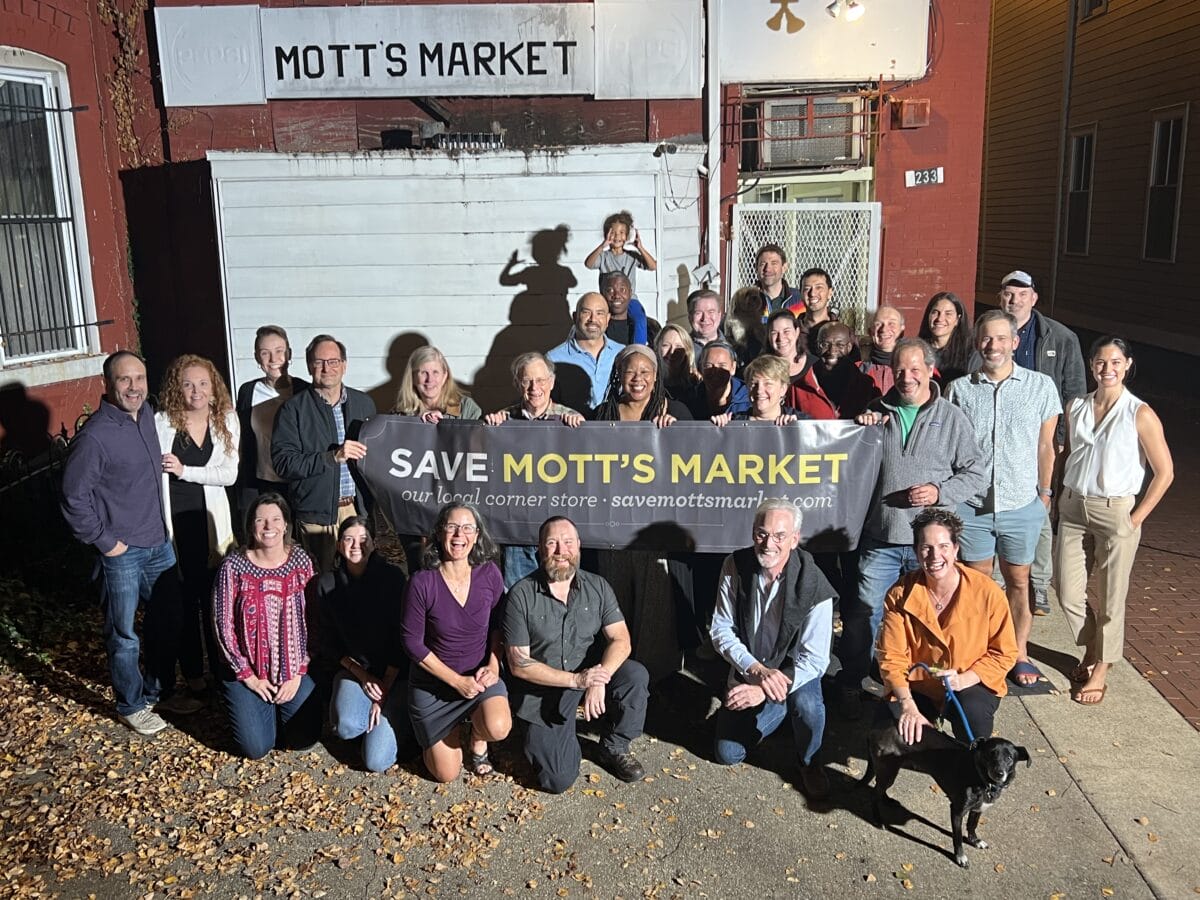
Members of the community who joined forces to save Mott’s Neighborhood Market.
In March, Aleta and I had a wonderful opportunity to connect with a group of nonprofit changemakers in the Capitol Hill neighborhood of Washington, DC. We were leading a professional learning workshop, in partnership with the Capitol Hill Community Foundation, that focused on sharing our ABCDE of Learner Needs tool with practitioners working in schools and other nonprofits in the area.
During the workshop, I met Michael Skinner, the board president for Mott’s Neighborhood Market. Operating on Capitol Hill since 1916, Mott’s shut down in early 2022 when the owners needed to sell the building. Not content to let this community landmark disappear, thus eliminating an invaluable “third space,” Michael and his neighbors banded together to purchase the building and resurrect the market.
In learning more about their effort, I was struck by how effective the group of several dozen community members had been in pooling their resources—time, money, know-how—to pull it off. At a time when we can feel so isolated and disconnected from our neighbors, Michael’s story stood in stark contrast. I wanted to learn more!
So, I spoke with Michael, originally as part of the Inspired Teaching Curiosity Challenge for April, which is focused on community and connection. During our conversation, he shared so many pieces of advice that are applicable far beyond the work of the Mott’s Neighborhood Market crew. Michael’s insights (quoted below) are especially helpful reminders to teachers that a thriving community in the classroom and school building is necessary and accessible; community is people, after all, and classrooms are full of those!
Teamwork really does make the dream work. One person shouldn’t—and often, can’t—be the only individual tasked with all the responsibilities a group effort entails. Community is strengthened when we recognize the complementary skills each of us brings to the table. This is especially true for the young people learning in our classrooms. Some might excel in a subject that poses a challenge for others; how can we tap into the community here to support everyone?
“As with any project where novices are involved, none of us who were working on this had the right mix of skills, as an individual, to make this work. It really required people stepping forward and saying, ‘Well, I have experience with this,’ and ‘I have experience with this,’ and joining committees and making it happen. We have well over 100, households involved as active investors and many, many more who contributed through a buy-a-brick campaign.”
Work with what you have. When the community took over the market building in late 2022, it needed renovations, permits, and a proprietor before it could begin operating as a market again. Those things take time (nearly 4 years!), but rather than do nothing until then, the group got creative with the space instead. Often, there will never be a perfect time or situation in which to begin community-building efforts; the best time to start is always now.
“We didn’t want to wait for the market to open for it to serve this function of bringing community together…[We] got the building in October of 2022, and first thing that November, we did a food drive… We almost restocked the shelves with food that people donated, and then we were able to give that to organizations to redistribute to folks that needed food, not only for Thanksgiving, but for that entire holiday period. And we thought, ‘OK, well, let’s see if we can’t do more of these kinds of things because people really enjoyed running into each other at Mott’s again.’”
Tap into who the community is. Just like the diverse skillsets of community members, their experiences, perspectives, and cultural backgrounds are also resources ripe for creating connections. Engaging our curiosity about the people in our classroom, school building, or the surrounding neighborhood often results in a plethora of new opportunities for learning we may otherwise have missed.
“There’s a family that lives on 12th Street that is from the New Orleans area, and so we did a celebration of Mardi Gras… We had an entire event that was really trying to engage with people who lived in the neighborhood and used Mott’s Market decades and decades ago. So we had a choir from Saint Cyprian’s Church, which was traditionally an African-American Catholic church, that a lot of people that lived on Walter Street had gone to, and they came and performed a bunch of really lovely music.”
We make the world around us. There is a lot happening in the world right now that feels very much out of our control; our students feel this, too. But if the effort to save Mott’s Neighborhood Market can teach us anything, it is that we—as individuals and especially in community with one another—are the world and our actions can have a material impact on improving the conditions around us.
“I think one of the biggest gifts that we can give to children is a sense that we make the world around us, and that we have that ability as humans to help to shape the world…So if something isn’t the way that you want it to be, you have a right and an ability to step forward and join with other people and try to make something different.”
Hooray For Monday is an award-winning weekly publication of Center for Inspired Teaching, a social change nonprofit organization that champions the power of curiosity and is dedicated to transforming the school experience from compliance-based to engagement-based. Inspired Teaching provides transformative, improvisation-based professional learning for teachers that is 100% engaging – intellectually, emotionally, and physically.
