

November 10, 2025
By Aleta Margolis, Founder and President
Listen to this week’s Hooray For Monday podcast episode for the audio version of the newsletter.
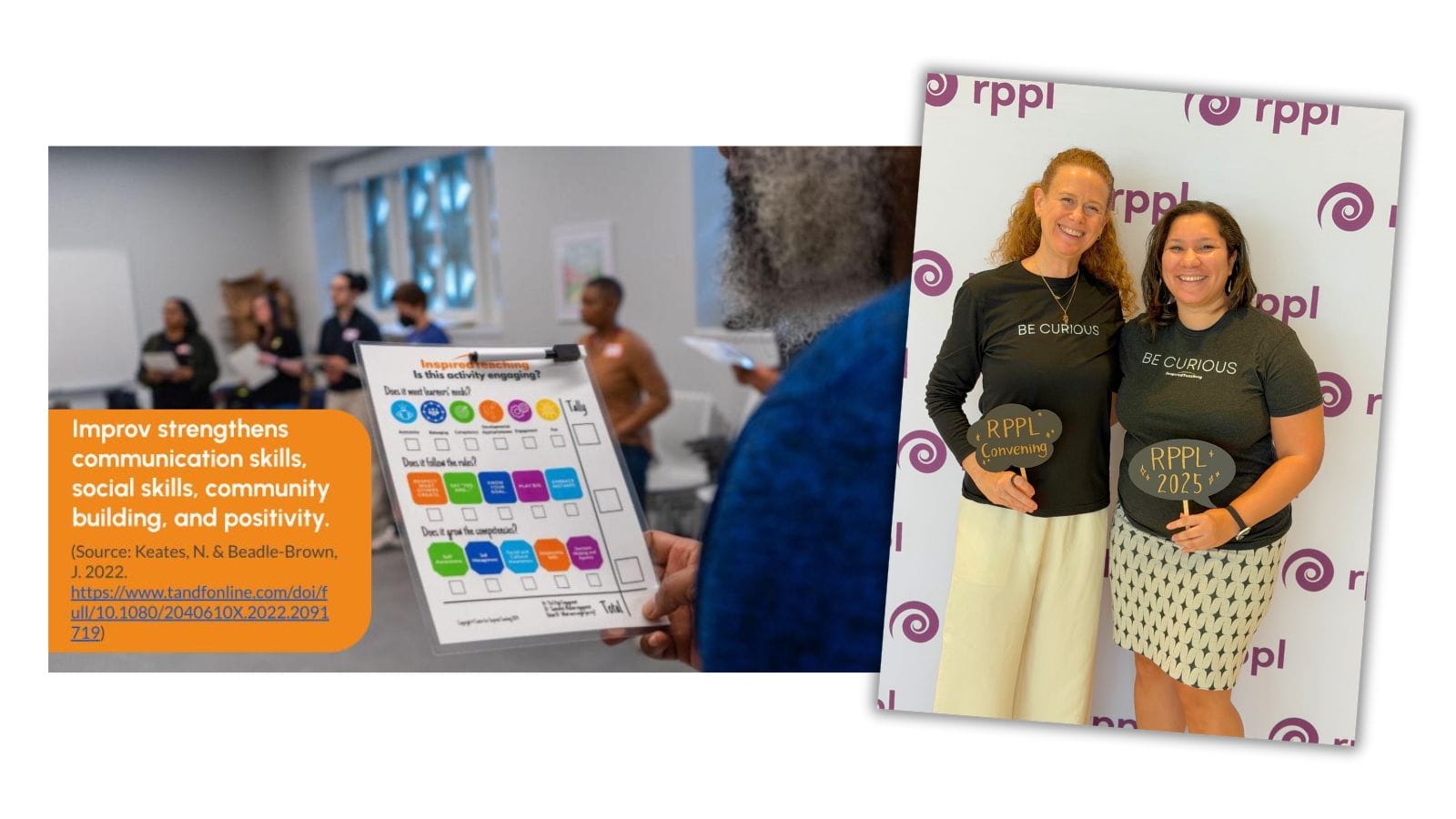
In Aleta and Maria’s conference session, participants learned to embrace uncertainty and curiosity; both are integral parts of an improvisational mindset.
I spent the first part of last week at an educational research conference where my colleague Maria Salciccioli and I presented a session called Improv for Professional Learning.
I’m delighted to report that the word “curiosity” surfaced many times throughout the conference. One of my favorite moments occurred when Jazzmyne Townsend, the 2025 Washington, DC Public School Teacher of the Year (and an interviewee for Inspired Teaching’s Curiosity Challenge!) said, “We need to approach new things with curiosity instead of fear!”
The good news is we agree that curiosity is important. Now, what do we do about it?
We can uplift curiosity in the posters we put on our classroom and school walls and the slogans we embrace.
That’s a good start. But it’s only a start. The next step is the most important one: we need to operationalize curiosity.
Here’s how that looks:
When a child does something…unexpected:
-
asking an off-the-wall question
-
engaging in unwanted behavior
-
misunderstanding an assignment
Be Curious! Resist the impulse to…
-
shut down the odd question
-
“correct” the behavior
-
direct the child to “pay better attention next time I’m giving directions.”
Instead…engage your curiosity.
-
Listen to the question and allow yourself to wonder what the child may have on their mind and ask a follow up question to find out.
-
See if you can figure out what unmet need(s) the child may be communicating with their unwanted behavior (utilize the ABCDEs of Learner Needs to identify and address them).
-
Pay attention to your students and look to see if others also misunderstood. If so, get curious about how you present directions and if and how you can be clearer and more concise. Engage the child who misunderstood. Ask what they thought the assignment was asking them to do; see what you can learn. Maybe the child has an idea or perspective you haven’t thought of!
When a child does something…wonderful:
Be Curious! Resist the impulse to brush it off with the usual “good job!”
Sure, saying “good job” lets students know we appreciate and approve of what they’ve done. But it can also be dismissive. (“OK, I checked the box and let you know your essay/drawing/answer to the math problem is good, now let’s get back to work.”) Worse, “good job” can teach our students to look to us (and others in positions of authority) to judge the worth of their work and neglect learning to do this for themselves.

Inspired Teaching Fellow Keisha Wilkinson encourages her students at Charles Hart Middle School in Washington, DC to approach difficult situations with curiosity.
You may be wondering… where will I find the time to operationalize curiosity?
I’m glad you asked!
Keep in mind that even with the long list of instructional objectives you need to address, each day you spend with your students is just one day out of a whole year of learning. And the whole year you spend with your students is just one out of over a dozen years those students will spend in school.
So, it makes sense to invest for the long term.
If we uplift curiosity when it comes to how we teach, our students will invest time grappling with complex problems, and experience the cognitive benefits of an engagement-based classroom. Investing time wisely means tuning in to what’s going on in the lives of our students. Listen to children’s ideas, questions, concerns.
Observe how they approach a science experiment, a conflict with a friend, an art project, an essay. Notice how they respond when they realize they’ve made a mistake in a math problem, what they do when they’re looking for something they’ve misplaced, how they enter the classroom when they’re running late.
Operationalizing curiosity means encouraging students to figure things out for themselves, to invent and re-invent meaning and information. This takes time upfront. But it brings extraordinary value in the long term.
For additional insights, resources, and information on Inspired Teaching teacher and youth programming, subscribe to the Hooray For Monday newsletter!
Hooray For Monday is an award-winning weekly publication of Center for Inspired Teaching, a social change nonprofit organization that champions the power of curiosity and is dedicated to transforming the school experience from compliance-based to engagement-based. Inspired Teaching provides transformative, improvisation-based professional learning for teachers that is 100% engaging – intellectually, emotionally, and physically.
