
Instigator of Thought activities offer teachers powerful ways to build their practice and hone their craft. By trying these activities, you are receiving ideas that are immediately useful and can spark professional learning – at your own pace and in a way that you control.
Saying “yes, and” means being open to students’ voices and believing that students’ knowledge, questions, and problem-solving strategies open up new routes toward reaching learning goals. Creating space for students to teach each other is one way to put those beliefs into action. Research shows that peer-to-peer teaching and learning not only brings student voice into the classroom but also improves academic outcomes. Students teaching each other also supports social emotional development and builds classroom community.
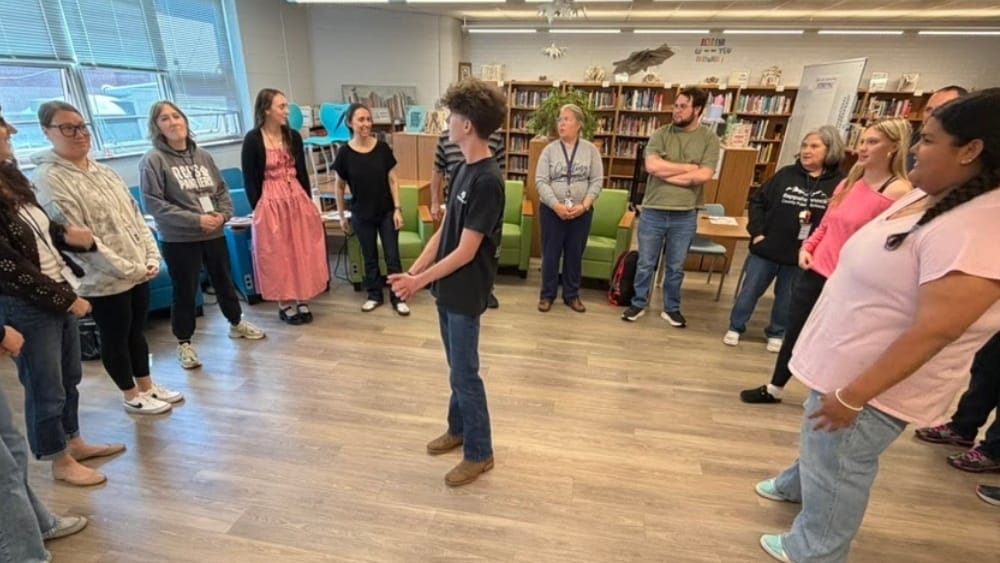
Students teaching each other can be as simple as a turn and talk, or as in-depth as a student planning and preparing a lesson on a topic she has chosen to study. The key is that students take the role of experts – sharing their knowledge with each other and with you and deepening their learning along the way.
What You Will Need:
-
30 minutes
-
Materials
-
An upcoming lesson plan
-
Directions
- Revisit an upcoming lesson you have planned. In this lesson, how many opportunities do students have to teach each other?
- Then reconsider this lesson: What teacher-led instruction (or even independent work) could be replaced by students teaching each other? Here are some possibilities to consider:
- Students lead morning circle or warm-up or do now
- Think-pair-share or turn-and-talk.
- Students each solve a problem or complete a task independently, then teach a classmate the strategy they used.
- Students directing questions to peers, rather than to the teacher
- Find an area in which each student is an expert. Over several days, designate each student the expert for the day in that area (e.g., in a writing lesson, one student is the expert at using question marks, another in adding dialogue, and another in using color to add expression).
- Book clubs or literature circles
- As you plan your restructured lesson, here are a few considerations to keep in mind:
- How will you pair / group students? Will students choose their partners / groups? Should groupings be homogeneous or heterogeneous?
- How will you support students in solving conflicts that arise?
- How will you guide students through misunderstandings about the content?
- How will you assess students’ learning when they teach each other?
- Count again: how many opportunities will students have to teach each other in your new lesson?
- Try it out!
