
March 30, 2026
By Aleta Margolis, Founder and President
Listen to this week’s episode of the Hooray For Monday podcast to hear from Inspired Teaching Fellow and math teacher at Dunbar High School in Washington, DC, Andrea Durio. Ms. Durio shares how and why she integrates virtual reality headsets into her students’ math lessons, and the pros and cons of technology in the classroom.
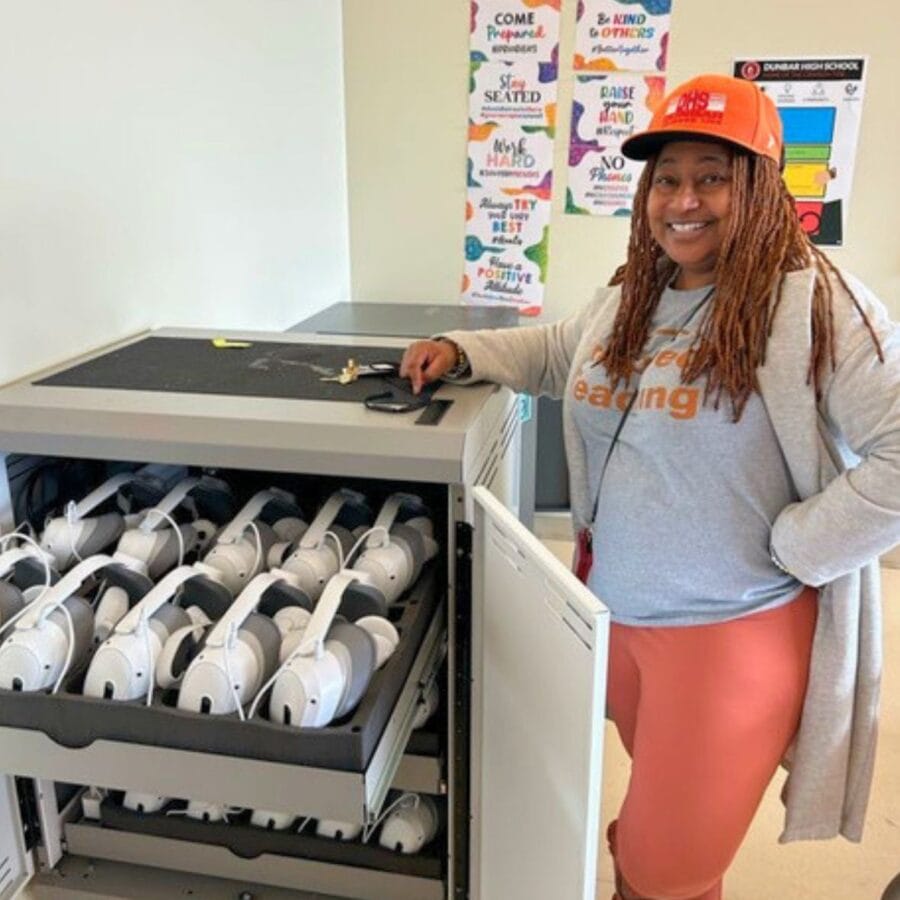
Andrea Durio with her VR headset cart at Dunbar High School in Washington, DC.
At the start of the school year, I shared a framework teachers can use to help guide their approach to artificial intelligence tools in their classrooms. Now firmly in the second half of the school year, we are no closer to any “answers” on the benefits or consequences of using AI in the classroom, to support us as teachers or for teaching our students. Yet, according to recent research from Pew, more than half of teen respondents say they use AI in some capacity to assist with school work; 10% use AI for all or most of it. Whether AI is good, bad, or somewhere in the middle, it is here.
While we far from having any certainty with AI use in the classroom, we do have a growing number of examples from educators around the world and researchers to help us navigate that uncertainty. So, in addition to the series of questions I shared last fall, here are 3 more curiosity-driven perspectives to consider as you prepare yourself and your students for the future:
When students rely on AI chatbots to do their schoolwork for them, it’s fair to assume they may no longer learn basic lessons, let alone experience the intrinsic motivation and curiosity of tackling tough problems on their own.
In Estonia, where the high school students were similarly leaning on commercially available chatbots as those in the Pew study, the Ministry of Education has responded by purposefully integrating AI technology into schools—but only as a driver of curiosity, not an extinguisher. The AI LEAP app is designed to ask students follow-up questions in response to a prompt, rather than providing answers. Teachers are offered nationwide training programs and opportunities to share best practices and student organizations are part of the piloting process before scaling use across the country.
Rebecca Winthrop, co-author of The Disengaged Teen whom I interviewed ahead of the release of that book in October 2024, is also a senior fellow and director of the Center for Universal Education at the Brookings Institution. Because of her work on engagement, she frequently writes on AI and its impact on children and learning.
Most recently, she and her co-author Jenny Anderson penned an op-ed for The Washington Post in which they argue that students should not be learning how to craft efficient chatbot prompts, but instead they should be engaging with how the chatbots work—who has designed them, what an algorithm is, where the data they regurgitate comes from, etc.
“The alternative approach — teaching a student how to use AI tools — is akin to teaching biology by focusing on instruments in a science lab: mastering the microscope or engineering the perfect petri-dish experiment. These skills are important, but they miss the bigger biological forces that shape the living world.”
Inspired Teaching Fellow Andrea Durio
Of the students who said they used AI to help with school work in response to Pew, more than half use chatbots to help solve math problems. So, how do you convince students that math is not just formulas to be memorized, but that understanding why 1+1=2 or pi=3.14 is critical to understanding the world around them?
Inspired Teaching Fellow Andrea Durio, a math teacher at Dunbar High School in Washington, DC, has spent the last three years doing just that—with an assist from virtual reality headsets. The VR element allows students to apply “hands on” learning to abstract concepts, like coordinate geometry through “rooftop gardening” and climate change through “glacial melting in Alaska,” within the walls of their classroom.
When her school was chosen to pilot a curriculum that integrated VR technology, Ms. Durio made sure to focus on the ethics and outcome of using it.
“You can’t say ‘Don’t use it.’ You have to give them frameworks and guidelines,” she says. And, Ms. Durio noted, before she ever uses the tools to support a lesson, she tests it out herself. “As a teacher, you have to do each module so that you can help [your students] through it if they get stuck. So you don’t just tell them what to do, but [are able to] help them with meta-cognitive skills.”
After using the VR headsets, Ms. Durio observes better retention of math concepts, stronger critical listening skills, and more robust whole-class discussions after completing a module. You can hear more about her experience with and approach to this technology in this week’s Hooray For Monday podcast!
Hooray For Monday is an award-winning weekly publication of Center for Inspired Teaching, a social change nonprofit organization that champions the power of curiosity and is dedicated to transforming the school experience from compliance-based to engagement-based. Inspired Teaching provides transformative, improvisation-based professional learning for teachers that is 100% engaging – intellectually, emotionally, and physically.
